

Lease, Finance, or Pay Cash? How Your Choice Affects Your Business Vehicle Tax Deduction
When it comes to deducting business vehicle costs on your federal tax return, the main decision is whether to use the standard mileage rate or the actual expense method.
Small businesses (sole props, single-member LLCs/PLLCs taxed as sole proprietorships, partnerships, S Corps, etc.) generally pick one method per vehicle per year. The right choice depends on miles driven, vehicle cost, how you acquire it (lease, loan, or cash), business-use percentage, and recordkeeping capacity. Rules come primarily from IRS Publication 463 (Travel, Gift, and Car Expenses) and the annual standard mileage rate notices. https://www.irs.gov/publications/p463
***Note the mid-year change in the 2026 standard mileage rates (business use of a car, van, pickup, or panel truck):
January 1–June 30: 72.5 cents per mile
July 1–December 31: 76 cents per mile
These rates cover gas, oil, maintenance, repairs, tires, insurance, registration, and depreciation.
Business parking fees and tolls stand as their own deductible category. They are not built into the standard mileage rate and remain deductible whether you use the standard mileage method or actual vehicle expenses.
Vehicle loan interest is also treated as a separate deductible expense for self-employed taxpayers. It is not built into the standard mileage rate and may still be claimed when using that method.
Standard Mileage Method: Pros and Cons
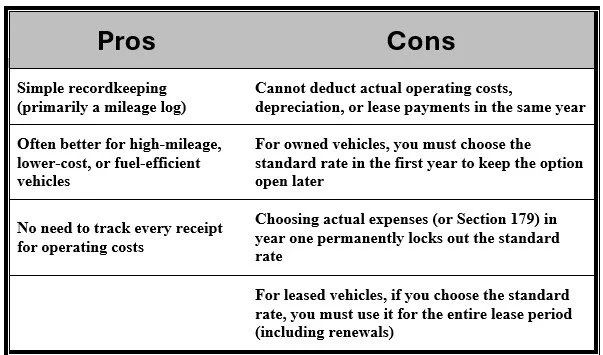
You generally cannot use the standard rate if you operate five or more vehicles at the same time (fleet rule) or in certain other situations (e.g., after claiming accelerated depreciation methods).
Actual Expense Method: Pros and Cons
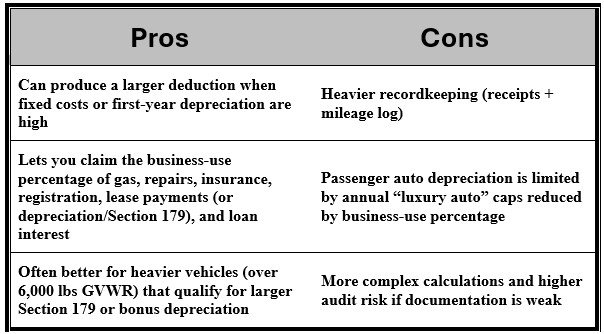
How Acquisition Method Interacts with the Choice
Leasing
You can use either the standard mileage rate or the actual expense method when you lease a vehicle.
If you use the actual expense method:You deduct the business percentage of your lease payments plus your regular operating costs (gas, insurance, repairs, etc.). Any large upfront payments are spread out over the full lease term instead of being deducted all at once.
One extra rule applies to higher-priced cars: If the vehicle’s value is above the IRS limit for the year you start the lease (recently in the low $60,000s), you may have to reduce your deduction by a small amount called an “inclusion amount.” This keeps the tax benefit of leasing a more expensive car closer to the limits that apply when you buy one.
If you use the standard mileage rate:You must stick with that method for the entire lease term(including any renewals).
Other points to keep in mind:
Because you don’t own the vehicle, you don’t build equity and you can’t claim big first-year depreciation write-offs (like Section 179 or bonus depreciation).
Leasing is usually easier on cash flow because of the lower upfront cost, but the business ends up with no residual value when the lease is over.
Financing (Taking Out a Loan)
You can use either the standard mileage rate or the actual expense method when you finance a vehicle.
If you use the actual expense method: You can deduct the business percentage of the loan interest, plus the business percentage of your operating costs. You also recover the cost of the vehicle over time through depreciation (or bigger first-year write-offs like Section 179 or bonus depreciation, if you qualify and use the vehicle more than 50% for business).
If you use the standard mileage rate: The mileage rate already includes an amount for depreciation. Self-employed people can usually still deduct the business portion of the loan interest separately.
Other points to keep in mind:
You build equity in the vehicle as you pay it off.
The ability to deduct the interest is an extra tax benefit you don’t get when you pay cash.
Paying Cash
Paying cash is similar to financing when it comes to depreciation. Under the actual expense method, you can still write off the cost of the vehicle through depreciation or first-year write-offs (like Section 179), based on your business-use percentage.
The main difference is that there is no loan interest to deduct.
Other points to keep in mind:
You put out the full cost of the vehicle upfront. While this avoids interest charges, it also ties up more of your cash.
The same first-year rules apply if you want the option to use the standard mileage rate later, you generally need to choose it in the first year the vehicle is used for business.
Business vs. Personal Use Percentage and Documentation Requirements
Your business-use percentage is simply the number of business miles driven divided by the total miles driven during the year.
You need solid records that show both the business miles and the total miles.
Driving between your home and a regular workplace is almost always considered personal use and cannot be deducted.
Important thresholds to know:
You generally need to use the vehicle more than 50% for business to claim bigger first-year write-offs (like Section 179 or bonus depreciation) or faster depreciation methods.
If your business use drops to 50% or less, you may have to pay back some of the depreciation you previously claimed, and you’ll be limited to a slower depreciation method going forward.
What records do you need?
The IRS has strict rules for vehicle deductions. For every business trip, your records should show:
The date
Where you went
The business purpose of the trip
How many miles you drove
You should also record the odometer reading at the beginning and end of the year.
If you’re using the actual expense method, keep receipts for the costs you’re claiming (gas, repairs, insurance, etc.).
It’s best to record this information at or near the time of each trip. Logs created months later from memory are often rejected by the IRS. If you can’t properly support your deduction, the entire vehicle write-off can be disallowed.
Practical Guidance for Small Businesses
Run the numbers both ways, especially in the first year you put a vehicle into business use.
High business miles in a lower-cost vehicle often favors the standard mileage rate. An expensive or heavy vehicle with moderate miles and strong first-year write-offs often favors the actual expense method.
Work closely with your bookkeeper from the start. Once you choose the standard mileage rate or the actual expense method, tell your bookkeeper right away so vehicle costs are categorized correctly.
The two methods are tracked differently in your books. Setting this up properly at the beginning keeps your records clean going forward, makes tax time much easier, and helps you avoid errors or missed deductions later.
If you’re not sure which method has been used on prior tax returns, contact your tax advisor and ask.
Knowing whether the standard mileage rate or the actual expense method was used in earlier years helps you avoid mistakes and make better decisions going forward.
Keep a current mileage log (paper, spreadsheet, or a mileage app that captures the required details).
Clearly separate business and personal use. Mixed-use vehicles need careful tracking.
Coordinate vehicle decisions with other tax choices (such as Section 179, bonus depreciation, or S-corporation reasonable compensation).
Tax rules can change and may interact with state law, your business structure, and the specific vehicle (weight, etc.).
Important note: This is general information based on IRS rules as of 2026. It is not tax, legal, or accounting advice for your specific situation. Vehicle deductions depend heavily on your facts and the quality of your records. Talk with a qualified tax professional before making elections or filing your return.
Ready to make sure you’re using the right method for your business vehicle?
If you’d like help reviewing your situation or setting up clean records that support your tax strategy, feel free to reach out. I’m happy to talk through your options so you can move forward with clarity.
Key official sources
IRS standard mileage rates page: https://www.irs.gov/tax-professionals/standard-mileage-rates
2026 rate announcement (initial): https://www.irs.gov/newsroom/irs-sets-2026-business-standard-mileage-rate-at-725-cents-per-mile-up-25-cents
Publication 463 (Travel, Gift, and Car Expenses): https://www.irs.gov/publications/p463(and PDF at https://www.irs.gov/pub/irs-pdf/p463.pdf)
Related guidance on depreciation and listed property appears in Publication 946. https://www.irs.gov/pub/irs-pdf/p946.pdf